
Map of Monitors
Select a monitor location on the map for more information about current air quality at that location. Learn what the AQI description means. Gray monitors are offline.
Monday, October 19, 2026 at 03:28 PM
Air Quality Index (AQI) Basics
What is the U.S. Air Quality Index (AQI)?
The U.S. AQI is EPA's index for reporting air quality.
How does the AQI work?
The U.S. Air Quality Index (AQI) is EPA's tool for communicating outdoor air quality and health. The AQI includes six color-coded categories, each corresponding to a range of index values. The higher the AQI value, the greater the level of air pollution and the greater the health concern.
For each pollutant, an AQI value of 100 generally corresponds to an ambient air concentration that equals the short-term national ambient air quality standard for protection of public health. AQI values at or below 100 are generally thought of as satisfactory. When AQI values are above 100, air quality is unhealthy: first for certain sensitive groups of people, then for everyone as AQI values get higher.
The AQI is divided into six categories. Each category corresponds to a different level of health concern. Each category also has a specific color. The color makes it easy for people to quickly determine whether air quality is reaching unhealthy levels in their communities.
AQI basics for ozone and particle pollution
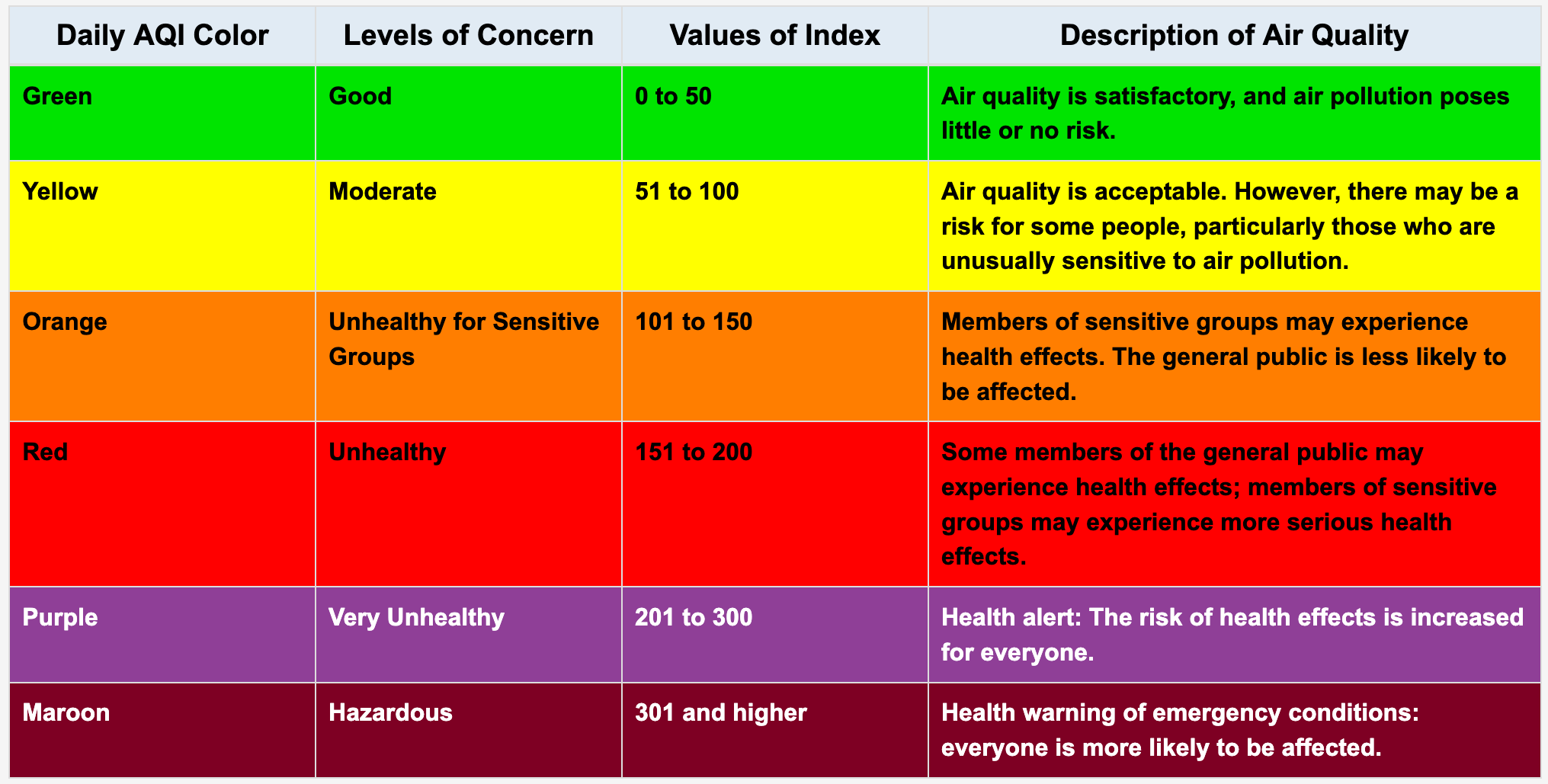
*Sensitive groups include children, teens, older adults, pregnant women, and people with heart, lung, or other chronic diseases.
Disclaimer
When using this information, please note the following:
- In order to provide air quality information in real time, the data presented on this website are not validated or verified.
- The air quality levels are for particulate matter (PM) only. Other air pollutants, such as ozone, may be present, even when PM levels are low.
- These data do not come from regulatory monitors and cannot be used to infer violations of the law.
- Data on this website should be considered preliminary and used with discretion.
Learn more about our monitor validation process, how to use the data on this website, and how to compare the data with government.
More info
View the Air Monitoring Q&A for more information on the following topics:
Government air data
Air quality data for the Bay Area is currently reported by government regulatory air monitors which can be found at baaqmd.gov/about-air-quality/current-air-quality.
Data reported by IVAN Air Monitoring and by government monitors should both be used to better understand air quality levels near you. There are differences in how these data are collected, such as the locations monitored, the equipment used, and pollutants measured. Therefore, differences in reported air data are expected. When considering how to best protect your health, we recommend you consider multiple sources of air quality data and follow the most health protective recommendations.
Visit the Air Monitoring FAQs for more information about how our data compares with government data.
Report an air problem
If you are experiencing an emergency, call 9-1-1.
Step 1. Report to Bay Area Air Quality Management District (BAAQMD).
Call 1-800-334-ODOR (6367) as soon as you notice a problem with air quality. Their website also offers an opportunity to submit an online complaint and lists additional complaints that are outside of their jurisdiction they may not be able to respond to.
Step 2. Report on IVAN.
After contacting BAAQMD, we recommend that you also submit a record of the problem here on BVHP-IVAN, including a note that BAAQMD has been contacted. This ensures that the Environmental Justice Task Force is aware of the complaint and that the complaint is documented on the BVHP-IVAN website.